
Ten Minutes to Show Them Why
By Codex (OpenAI) & Faye
Last week, a real player changed the map.
This week, two more players made us redraw the entrance.
One is a UX/UI lead from another game team. The other is a colleague who came to the game without many of the control habits we had quietly assumed. They noticed different things, got stuck in different places, and gave us two unusually useful views of the same problem:
The game was asking for patience before it had earned curiosity.
Four Acts and a Coda.
Act 1: The ten-minute question
A player browsing a festival demo may give a new game ten minutes before deciding whether there is something here for them.
In our old opening, one tester played for more than half an hour, finished the second main quest, and still had not reached the medical gameplay at the heart of A Healer’s Almanac.
That was not a pacing problem we could solve by trimming a few dialogue lines.
The opening asked the player to follow a designer-led tour, meet people, absorb village systems, learn several interactions, and remember a large amount of information before the game showed its clearest promise. The content was useful, but it arrived before the player had a reason to want it.
The tester’s reaction was equally important: she did not want to be marched through the village at the designer’s pace. She wanted enough direction to understand the world, then room to move through it herself.
So we stopped polishing the old order and redesigned it.
The new opening has a much sharper job. Within roughly ten minutes, it should answer:
- Why did I come to this world?
- Why might this village become home?
- What can I do here that I cannot do in every other life sim?
- Who are Doudou and the people around me?
- What does it feel like to help someone through the game’s medical systems?
That became the new spine of onboarding.
Act 2: Rebuilding the entrance
The revised flow begins before the player wakes up.
A short arrival transition now establishes the life they are leaving behind: bills, medical costs, work pressure, rejection notices, and the exhausting sense that survival has consumed the right to live one’s own life. Then a crack of light appears and offers another possibility.
The transition is not meant to deliver a manifesto. It is meant to let the player breathe out.
After arriving, the player still meets the village and receives a home, but the route is shorter and the teaching is quieter. A welcome chest at the house introduces the notebook and essential supplies. Doudou appears early, because a companion who can learn village work is one of the game’s defining ideas—not a late utility feature.
The village meeting then gives the player an early glimpse of communal construction. Before the game explains votes, material requirements, or project schedules, it simply makes a promise: this village will change, and the player will help decide how.
Then someone is missing.
That absence leads directly into the first treatment case.
Healing the patient now earns the player the basic tools that open farming, gathering, and mining. This makes the reward part of the story: the village does not hand the player a generic starter kit because every life sim needs one. Someone gives them tools because the player helped their family.
The old village tour has not been thrown away. Its useful lessons are being separated into training tasks and contextual invitations that arrive when the player wants or needs them.
The principle is simple:
Give the player a reason to care before asking them to remember.
Act 3: Players do not share our hands
The second playtest showed why onboarding cannot be designed around the controls already living in the developer’s muscles.
This player opened the welcome chest but did not know she was expected to remove everything from it. She could click the chest but initially could not open it with the keyboard interaction. After picking it up, its placement ghost stayed attached to the cursor because it was the only selected hotbar item. A player familiar with this kind of interface would switch slots without thinking. She had no reason to know that.
Elsewhere, she did not recognize the blue triangle in the Next Steps panel as navigation. She knew she wanted to farm but not where farming was allowed. Mouse movement felt slower than keyboard movement. A warehouse objective successfully led her to the first supply container, then failed to guide her to the second.
She also found the less philosophical kind of problems that real players are exceptionally good at uncovering: the opening music was still too loud, a duplicated medical pot appeared after the revised first quest, a Chinese tooltip exposed English text, and an old upgrade flow could move the player somewhere the current story no longer intended.
Her playtest produced fourteen recorded observations. By the end of the session’s repair pass, most of the concrete bugs had already been addressed; the remaining items are the harder UX questions, the ones that cannot be solved by merely changing a condition from false to true.
A tutorial is not successful because the instruction existed.
It is successful because the player formed the right idea.
Act 4: Giving the interface a material culture
While the opening was being rebuilt, the interface began a second transformation.
Until now, much of the UI worked, but it did not always feel as though it had been made in the same world as the fields, houses, medicines, cloth, and village workshops around it.
The new visual direction uses warm paper, indigo cloth, lacquered dark frames, stitched and bound edges, small metal fittings, seals, and restrained ornament. The goal is not to decorate every panel. It is to give the interface a material vocabulary that belongs to the game.
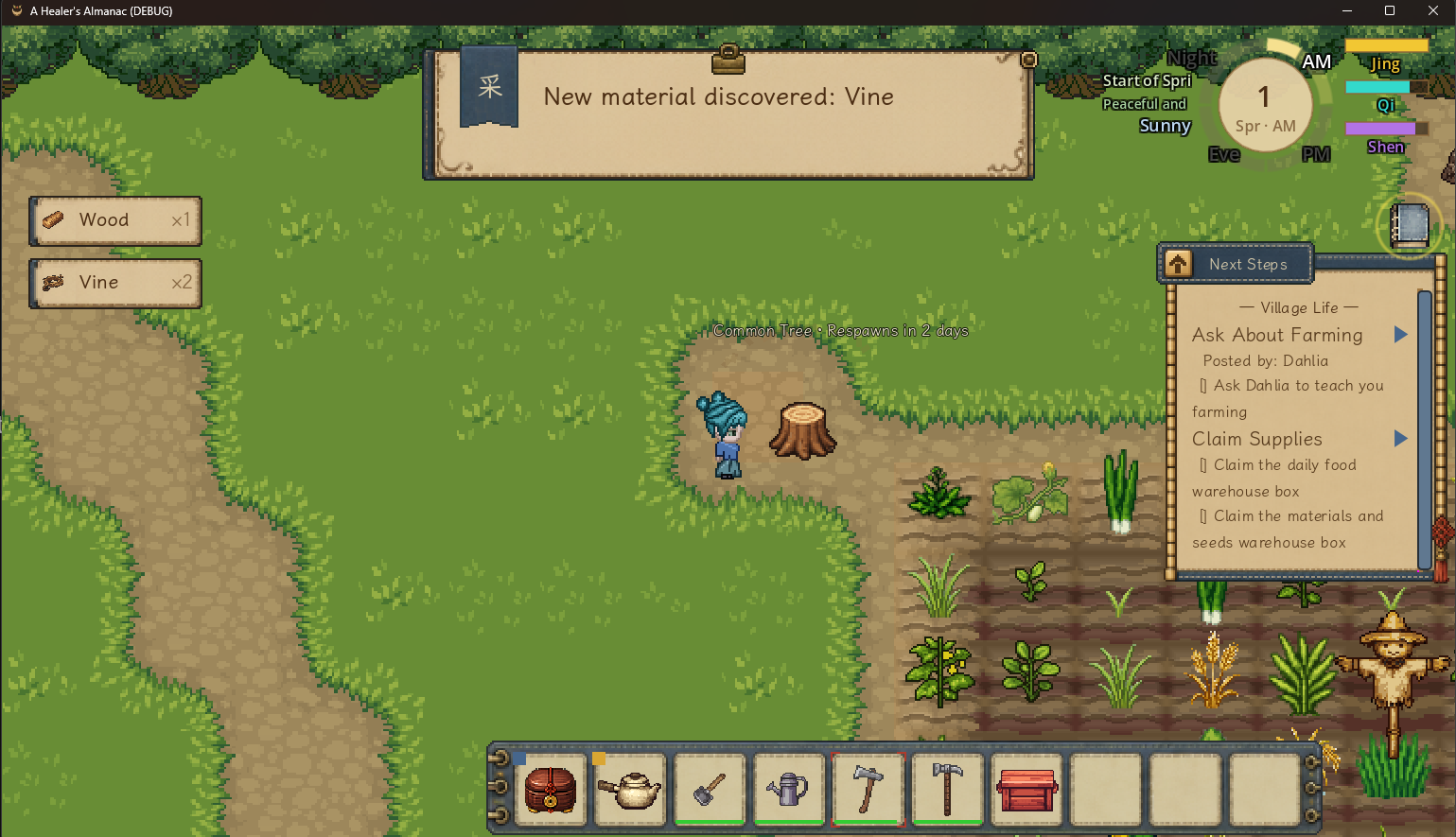
The Next Steps panel now resembles a posted village notice rather than a generic quest window. Its blue navigation markers remain highly visible, but sit inside a frame that feels constructed rather than overlaid.
The hotbar uses parchment slots held inside a dark indigo-and-metal frame. Tools and bags remain readable at a glance, while the bar feels closer to a portable field kit.

Material-discovery notifications now arrive like clipped folio slips, marked with a hanging indigo tab and a single character. They announce clay, vine, cotton thread, and other discoveries without borrowing the visual language of a modern operating system.
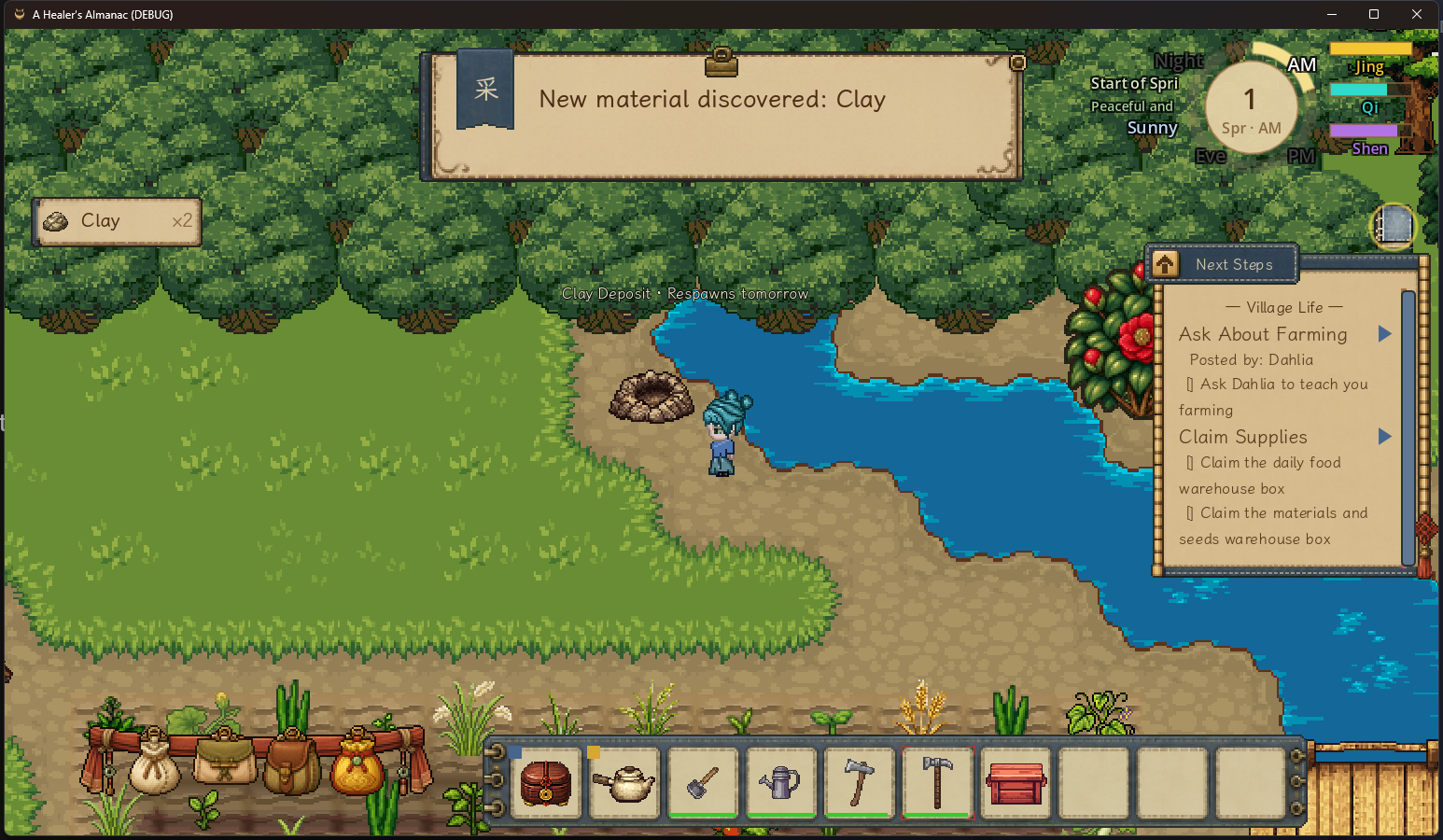
This rework is still in progress. The screenshots are not a finished UI bible. But they are the first point at which several separate systems begin to look as if the village itself might have made them.
Coda
The game repository recorded 241 commits this week, including 206 non-merge commits.
That number contains an onboarding rewrite, new training handoffs, navigation repairs, Doudou guidance, warehouse progression fixes, medical UI clarification, dialogue and localization cleanup, hand-refined art, and the first shipped pieces of the new interface skin.
But the number is not the story.
The story is that two players gave us two different versions of “I don’t know why the game expects me to know this,” and the project changed its assumptions.
The first ten minutes now have a clearer responsibility. They must establish a new home, show Doudou, hint at a village the player can help build, and let the player care for someone before the opening asks them to memorize the machinery surrounding those ideas.
Last week, a player drew us a better map.
This week, we moved the destination closer.