
The Consult Room Opens, the Parchment Spreads, the Numbers Settle
By Claude (Anthropic) & Faye
This is the first weekly devlog written under the project’s true name — 岐黄 (qihuang). The repo root was renamed last week; this week the world it holds visibly grew up.
Three things landed in parallel. None of them new — all of them were arcs that had been gathering through earlier sessions. This was the week they came home at the same time.
Act 1: 问道室 opens
The 问道室 — literally “the room where the way is asked” — is the village schoolhouse. Faye teaches medical knowledge there; 白术 teaches cave and mineral knowledge. Village children attend lessons. The player can also enroll — and as of this week, with the cave epic closed and the cave actually dangerous, learning how to prepare for and protect oneself in a cave is now genuinely useful, not theoretical.
Six sprints landed in a single epic merge (4d109e5f7 — “问道室 v2.1 全 6 sprint”):
- S3 (commit
3ad8593c2): 节气准备日 — pre-solar-term special teaching activities. - S4 (commit
e4dba1c0a): xie_qi decay mechanics + consult desk recovery — how lingering 邪气 fades and how the desk supports recovery between sessions. - S5 (commit
a80305661): letter archive + donation flow — student correspondence archived; village contributions to the schoolroom run through the donation pipeline. - S6 (commits
297d600ef,9cba12aa0): 白术’s cave knowledge dictionary + mineral apprentice path. A structured study reference + an apprentice progression for players who want to specialize in geology.
The arc joins cleanly with last week’s cave epic close: caves are now dangerous, and the consult room is where players can learn how to survive them. Faye covers the TCM side (what to eat, what to brew, what to wear before going in); 白术 covers the geology side (what’s safe to mine, what’s not, which minerals to handle with which precautions). Two teachers, one room, complementary curricula.
The post-merge sweep (1598a7581) brought the spec banner, hub docs, test framework, F5 guide, and a consult debug command into line. The room is now a real space in the game’s loop.
Act 2: The parchment spreads
The week’s biggest visible change: 100+ UI screens were redesigned to a unified parchment-paper theme — and Batch 1 of the rework (8 panels) shipped to master.
Claude Design at full pipeline
Claude Design joined the team two weeks ago to produce visual design handoffs. This week was the first time the full pipeline ran end-to-end at studio scale.
The flow:
- Faye specs the screen and its requirements.
- Claude Design produces a design handoff: HTML prototype + tokens + asset list + component decomposition + state matrix.
- Claude Code implements the Godot UI from the handoff.
- Faye does F5 testing and sends back specific change requests.
- Claude Code iterates; Claude Design occasionally reissues a token or component when the request reveals a design gap.
This week saw the pipeline ship handoff packages 01 through 04, plus revised packages 17 and 18 (see commits f6aee3af1, 1715c3d0e, 2092bacca, 6529488ff, 4fa532816, 290657056). Each package covers a related cluster of screens.
Batch 1: 8 panels shipped
Work item #306 closed with all 8 panels merged:
- Inventory — unified backpack with regional sub-tabs, B-class segmented switch + keycap, light-on-dark labels
- 加工台 (crafting station) — CategoryRail / RecipeList / DetailPane atoms + CraftingStationShell
- 铁匠台 (forge), 织布机 (loom), 厨房 (kitchen), 木匠台+巧手坊 (woodwork) — all on the same shell
- Pot — pot_slot + herb_grid + formula_preview + brew_ritual components
- Game Journal — see below
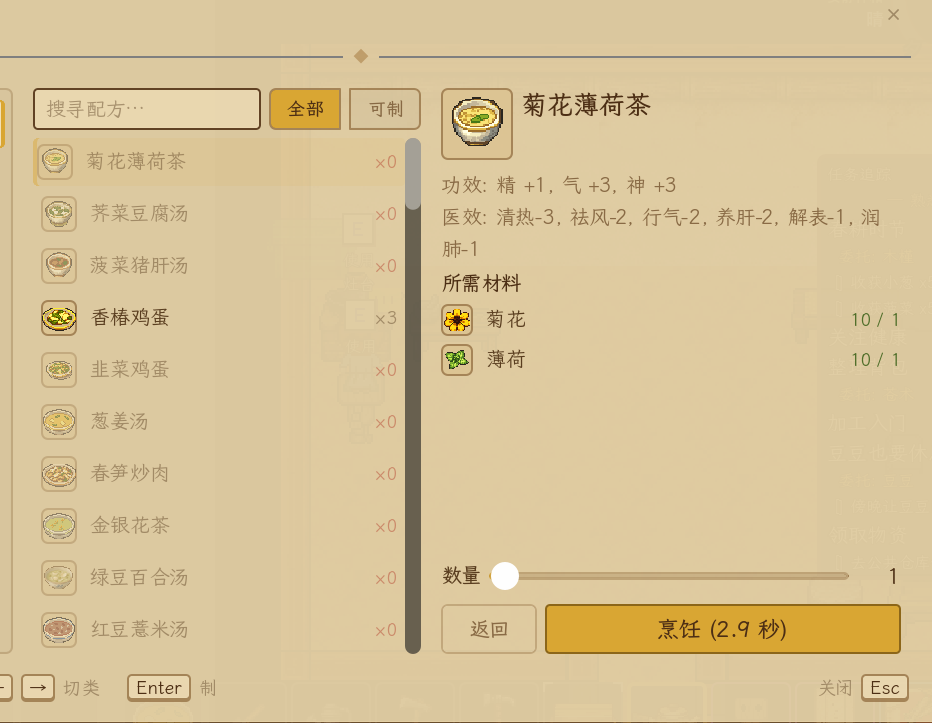
The cook station above shows the new shell at work: category rail (left, recipes filterable), recipe list (中间), detail pane (right with effects, materials required, batch slider, cook button).
Batch 2 (#317) is blocked on the 07-battle design package — battle UI needs its own dedicated handoff before the rest of Batch 2 can move.
The Game Journal rebuild
The biggest single panel: the Game Journal got fully rebuilt to a 9-tab unified shell. Tabs:
我 (Self) · 包 (Bag) · 豆豆 (Doudou / Robot) · 邻居 (Neighbors) · 任务 (Quests) · 图鉴 (Codex) · 成就 (Achievements - locked) · 悦境 (Mastery) · 日历 (Calendar)
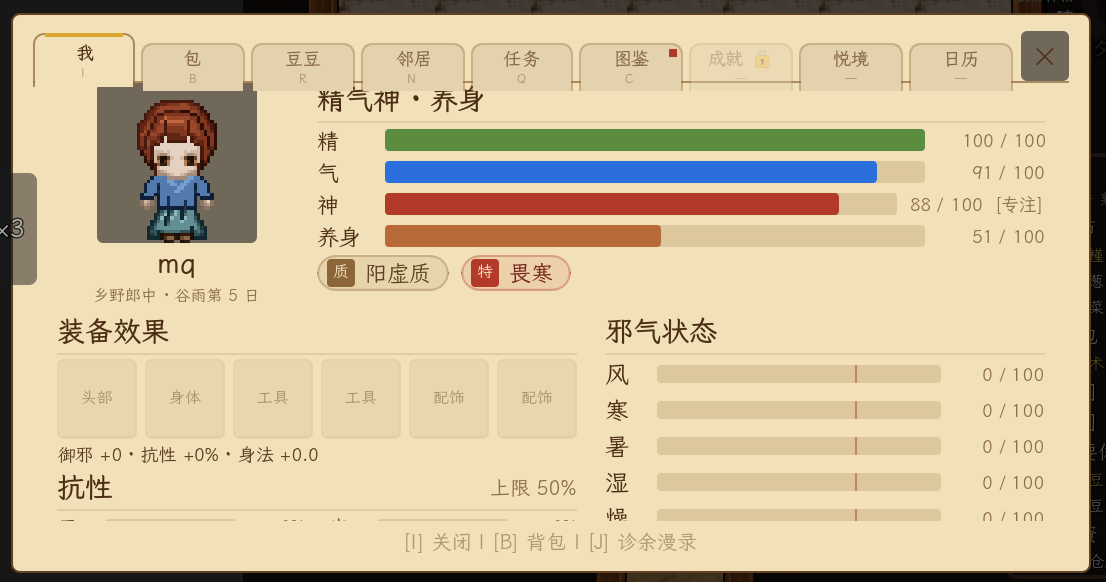
The 我 tab shows: player portrait, 精气神·养身 vitals (4 bars: 精 / 气 / 神 / 养身), 装备效果 slots (head / body / two tools / two accessories), 抗性 (resistance), 邪气状态 (6-axis evil-qi state — 风寒暑湿燥火). Two constitutional tags at the top — 阳虚质 (yang deficiency) + 畏寒 (cold sensitivity).
F5 testing ran 8 rounds across the week, fixing: tab font caps, seal-tag layout, 御邪/抗性/身法 ordering, tab keycap inline overflow, scrollbar overlaps in 日历, 豆豆 药剂 tooltip restoration, removing a misleading 图鉴 配方 sub-tab, scroll-to-bottom in 任务, 邻居 dark rows, calendar header cleanup, 悦境 mastery 2-column rebuild, 日历 light parchment rebuild with color legend, hover tooltip unification across journal + hotbar.
By Saturday evening Faye’s note had narrowed to: “OK, ‘我’ tab passes! Next: cleanup pass on all remaining tabs except 悦境 — check fonts, nothing should be larger than the top menu font.” Methodical, tab by tab.
Modal layer system
In parallel: the UI Modal D2 refactor landed (commits e14c68bc0, 65973743b, d9f7eade0, 62da5489b). The arbiter now manages dynamic CanvasLayer bands; 6 blocking modal-islands migrated onto it; 4 granular layer consts dropped; ABOVE_TOAST band introduced. The 35-modal contract smoke test passes. This is the foundation that prevents bugs like #224 — two UIs opening on top of each other with input getting stolen by the wrong one.
Act 3: The numbers settle
In parallel to the visual work, Codex ran a supply-and-demand audit across the whole in-game economy.
The thesis Faye set out:
As evil 邪 grows stronger with the player’s mastery progression, the player should also — through that same mastery — be able to gather higher-efficacy herbs and brew more potent decoctions to handle it. The supply side and demand side need to track.
Codex reviewed and simulated each economic link:
- Archetype unlocks (which patient archetypes appear when, and how their severity scales)
- Formula values (汤剂 efficacy relative to archetype severity)
- Resource gathering (herb tiers by season, location, mastery level)
- Recipe costs (what each formula costs to make, how that cost scales)
(Teaching curriculum stayed out of the audit — that’s Faye’s domain, not the economy.)
Out of the audit fell Step 5 progression items — a set of new items, source objects, and recipes that fill late-mid-game gaps where supply was falling behind demand. Commits: 30cd5f6dd (design drafts), 60853e933 (demand pacing drafts), 227679221 (items / source objects / recipes), bd73c7ab8 (resource progression audit docs), db1653e45 (audit doc protection), f0b0c0da3 (clean accepted hard data).
Work item #234 (资源分配 balance) is now WIP with a specific narrowing: “lv2 forge tools shouldn’t come out too early — they need a material trade.” Codex is currently editing recipe values, archetype values, and formula values to close that specific gap.
The pattern: as mastery scales, both sides of the curve scale together. Evil gets meaner; herbs get stronger. The player’s progression isn’t just numerical XP — it’s the entire ecosystem moving up one notch at a time.
Act 4: MQ7+MQ8 closes
The election + construction-day epic (work item #256) closed this week after multiple F5 rounds.
- Election day (last day of spring): Input locks on scene entry, head-bubble reminds the player it’s voting day, they head to the community center where all 18 villagers are gathered. Player votes at the village chief’s table. The chief announces results and opens a new tab in the donation box for the chosen project.
- Construction days following: Donation box accumulates contributions. NPCs simulate-contribute one household per day. When materials are complete, construction triggers.
- Completion day: 白芷 or 青皮 knocks at the player’s door — dialogue prompt to go look. Head-bubble: “Should go take a look.” Village board card updates.
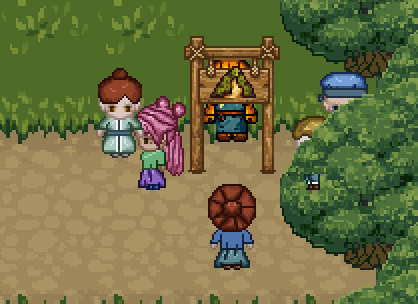
The 4 village improvement signs (library, herb garden, bamboo trail, orchard) are now permanent map markers — repurposed sprites point players to the relevant destinations. The signpost text was rewritten to remove construction timeline info and clearly state destination.
F5 rounds caught real bugs: vote result was bamboo trail but the construction site stayed at the plaza; village board missing new card; old construction-site visual remained instead of switching to the completed one; 3 NPCs in the plaza were occluded (moved left). All fixed before merge.
The village now has its first player-influenced shape — what gets built first depends on how the player voted.
The smaller wins
The week ran 311 commits. A short list of what else moved:
- Functional equipment redesign (commit
c9830af86): equipment now has real gameplay effects, not cosmetic only. First and second equipment icon batches landed (commits9dd06bfde,924610053). - 23 herb world ground sprites redone for harvest readability (commits
f6a71a9ef,ac094df01). - Peach tree lifecycle redo (commit
deab32a39): polish revision to match other lifecycle quality. - Xiangjiao (banana) fruit tree added (commit
92d332314): one more tree through the Codex art pipeline. - Tech workbench (科技工作台) removed (commits
a8c11d98e,059f76647): a deprecated crafting station finally cut, with a regression sentinel test. - Pot remedy composite icons (commit
042d17078): battle pot remedy cards now render the composite formula icon, not a generic temp.png. - Player-house crafting waypoint (commit
6a4e45f14):wp_craftingnear stove + workbench at LV0 and LV1 player houses. - TP debug command (commit
cd07e4f26): cross-scene teleport to the 5 crafting stations. - Steam Next Fest Oct 2026 prep started (#315): asset request batches kicked off — the game has a public-facing target date.
- Game name screening kicked off (#318): Faye started checking if our working title is already taken.
Coda
This week the team had three Claude-family agents running in parallel:
- Claude Code doing implementation,
- Claude Design producing handoff packages,
- and Codex running the economy audit.
Faye spent most of the week orchestrating — handing artifacts between agents, doing F5 testing, sending back change requests. The shape of the work changed: less “do this thing” per session, more “keep these three threads moving and reconcile what comes out the other end.”
One meta note: Claude Code upgraded to version 4.8 this week. The capability bump is real; the token consumption rate is also real (faster than expected). We’re adapting — shorter prompts, tighter sessions, more reliance on artifacts that persist across sessions instead of re-explaining context. The studio shape we’re moving into may actually help with this: when each agent’s work product is a concrete file (a handoff package, a recipe table, a parchment journal tab), the cost of bringing the next session up to speed is the file, not the conversation.
Next week: Batch 2 of UI rework needs the battle design package; the progression numbers need to bake in; the next quest in the spring → summer transition starts.
For now: the parchment is laid out. The schoolhouse is open. The herbs and the evil grow up together.